
DOT Regulations For Non-CDL Drivers

Many employers assume that if a driver doesn’t require a Commercial Driver’s License (CDL), they fall outside DOT regulations.
In reality, many non-CDL drivers are still regulated under federal rules, bringing strict requirements for documentation, qualification, and ongoing oversight. Learn which DOT regulations apply to your non-CDL drivers.
Understanding Driver License Types (CDL vs Non-CDL)
Commercial Driver License (CDL)
A CDL is required when a driver operates larger or higher-risk vehicles. This typically includes vehicles with a Gross Vehicle Weight Rating (GVWR) of 26,001 lbs or more, vehicles designed to carry 16+ passengers, and vehicles transporting hazardous materials.
There are 3 classes of CDLs (A,B,C) with endorsements for specialized qualifications for vehicles like school buses, tank trucks, tractor trailers, etc. CDLs are regulated by the FMCSA and come with stricter requirements. Drivers must meet federal standards for training, testing, medical certification, and ongoing compliance.
Non-Commercial Driver License (Non-CDL)
A non-CDL license is a standard driver’s license used to operate vehicles that do not meet the federal thresholds for a CDL, such as most cars, pickup trucks, and light-duty vans used for business.
Depending on how the vehicle is used, some DOT requirements may still apply.
Do DOT Regulations Apply to Non-CDL Drivers?
Yes, DOT regulations can apply to non-CDL drivers.
A driver without a CDL may still be regulated if they operate a commercial motor vehicle (CMV). According to the FMCSA, this includes vehicles used for business that:
- Weigh between 10,001 and 26,000 lbs GVWR
- Operate in interstate commerce
- Transport passengers or goods for compensation
If those conditions are met, the driver may be subject to federal safety regulations, even without a CDL.
View our infographic: Is Your Fleet DOT Regulated?
DOT Regulations For Non-CDL Drivers
Once a non-CDL driver meets CMV criteria, employers must follow many of the same compliance requirements as they would for CDL drivers.
Employment Application and Driver History
Before hiring, employers must collect a detailed application that includes at least three years of employment history, along with any known accidents and violations. This step helps establish that the driver was properly vetted before being placed on the road.
Motor Vehicle Record (MVR) Checks
An MVR review is one of the most important steps in evaluating driver risk. It provides a verified record of violations, accidents, and license status, offering a clear picture of a driver’s on-road behavior. Employers are expected to review this record at pre-hire and at least once every 12 months.
DOT expectations require employers to review an MVR before hiring and to re-evaluate it at least once every 12 months.
Annual checks only provide a snapshot in time. Risk can develop between reviews, which is why many organizations are moving toward continuous monitoring to close that gap.
Medical Certification (DOT Physical)
For certain regulated non-CDL drivers, a medical qualification is required to ensure they are physically capable of operating a vehicle safely. This typically involves completing a DOT physical exam conducted by a certified medical examiner and maintaining a valid medical certificate.
These certifications must be kept current, often renewed every two years, although some drivers may require more frequent evaluations.
Drug Testing
The DOT does not require drug and alcohol testing for non-CDL drivers. However, employers may choose to implement their own testing program based on company policy or risk tolerance.
Safety Performance History
Employers must make a good-faith effort to verify a driver’s safety record with previous employers. This includes reviewing accident history and any safety-related incidents. It provides additional context beyond what appears on a driving record.
Driver Qualification File (DQF)
All of this information comes together in the Driver Qualification File, which serves as the central record of compliance for each regulated driver. The DQF includes the employment application, MVRs, medical certification, verification of safety performance history, and documentation of ongoing reviews.
Simplifying Non-CDL Compliance
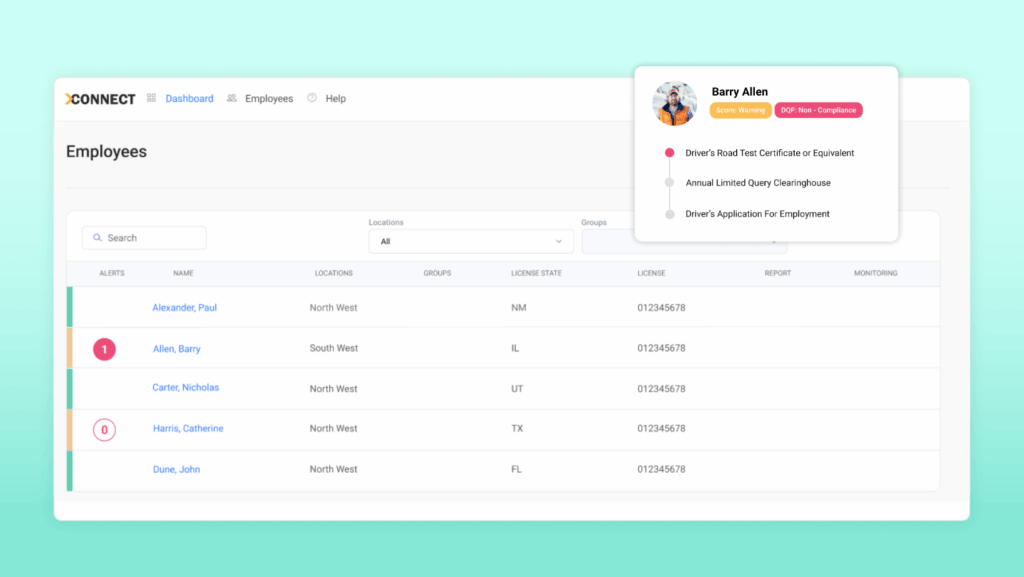
Driver compliance doesn’t have to feel like a constant burden. At Embark Safety, we help organizations simplify compliance with tools that provide real-time visibility, centralized records, and a more proactive approach to managing driver risk—so teams can stay ahead of DOT violations rather than react to them.
Explore how we can help you bring consistency, visibility, and control to your driver compliance program with MVR Monitoring, DQF Manager, Online Driver Training ,and more.
*We are not lawyers. Consult with your legal counsel to ensure your processes and procedures meet/ or exceed safety standards and compliance regulations. Please read our legal disclaimer.